The armed conflicts in Ukraine and, more recently, the fighting in Gaza serve as real-world examples that set in motion the long-lasting debate on the constraints of international law to promote humanity and to restrain brutality on the battlefield when states and non-state actors are fighting existential struggles.
This course provides you with tools to analyze the international humanitarian regulation of armed conflict within the framework of international law, with a focus on International Humanitarian Law (IHL) as well as International Human Rights Law (IHRL) and International Criminal Law (ICL). Through a mixture of readings, academic presentations, debates, and moot court exercise, you will be prepared to better understand the legal challenges of current and future armed conflicts and to critically analyze and evaluate concrete cases using legal, societal, and political approaches.
You only take one Core Course per semester, and each Core Course includes two Study Tours: one Short Study Tour to a nearby destination for three days, and one Long Study Tour to another European country for six days.
Led by your faculty, Study Tours take you into real-world settings where you will apply what you’ve learned outside the classroom.
Master of Arts in International Security from the University of Leicester (UK). Joint Command and Staff College (MA) 2010. Commissioned officer in 1996. In service since 1989. Multiple international deployments to conflict zones. Currently works as a military analyst focusing on security issues, including military security, Arctic geopolitics, and International Law. With DIS since 2018.
Dorthe Bach Nyemann
Master in Politics and History from University of Copenhagen 2000. Graduated in courses on International Law at the Master of International Security and Law from the University of Southern Denmark 2015. Worked as a teacher and planner of education at the Danish Army Academy for Junior Officers from 2005 to 2015. Currently employed at the Royal Danish Defence College researching cyber security and hybrid threats. Areas of expertise as a teacher are International Relations, International Law, and the art of writing large assignments. Engaged in international working groups related to the topic of my research. With DIS since 2021.
Long Study Tour
About this tour
This tour will enhance your understanding of how international organizations, such as the International Committee of the Red Cross (ICRC) and the United Nations (UN), work toward upholding the norms of humanity and a rules-based order in today’s armed conflicts. This trip revolves around Geneva, the international hub of humanity, and its role as home to international organizations, dialogue processes, and justice and reconciliation initiatives. Furthermore, the tour will allow you to visit one of Europe’s most picturesque areas, where the Alps are mirrored in the freshwater lake of Geneva.
Learning outcomes
Understand the role of Geneva as the international humanitarian hub
Understand the role of the United Nations in preserving peace and security
Gain understanding about the role of the International Committee of the Red Cross (ICRC) as the proponent of International Humanitarian Law (IHL)
Participate in discussions about the challenges and possibilities for enhancing compliance towards IHL in today’s world of complex armed conflicts
Possible activities
Visit the United Nations Headquarters and oversee an assembly in the International Human Rights Council or another assembly
Meet international and non-governmental organizations working to secure protection of the victims of armed conflicts and protected objects, e.g. critical civilian infrastructure
Attend lectures by the ICRC and go to the ICRC museum
Visit the Independent Investigative Mechanism for Myanmar (IIMM) and learn about the work it does to secure justice in the case of the armed conflict in Myanmar
Enjoy a day of hiking in the French Alps overlooking the Mont Blanc, including a trip in Europe’s highest cable car
About this tour
This week-long Study Tour to Sarajevo (Bosnia-Herzegovina), Belgrade (Serbia), and the surrounding region provides a critical case study on the function, application, and compliance (or lack thereof) with international humanitarian law in the Balkan conflicts of the 1990s. Together we will see how the current lack of transitional justice in Bosnia and Serbia impacts societal development, inter-ethnic reconciliation, and the international standing of both Bosnia-Herzegovina and Serbia.
We will visit key sites and monuments, as well as meet with strategic think tanks and academics, as we gain a fuller understanding of the complexities of the Balkan conflict through an examination of the 1999 NATO bombing of Serbia. Throughout the tour, we will engage with NGOs and young activists in Belgrade working on issues related to transitional justice, human rights, and post-conflict dialogue, allowing us to understand how members within a society strive to move forward post-conflict.
Learning outcomes
Critically apply International Humanitarian Law (IHL) and the definitions of genocide and war crimes to both past and current events
Reflect on the role of IHL in efforts to achieve reconciliation after serious breaches of International Humanitarian Law and War crimes
Immerse yourself in the rich cultural life of the Balkans, especially in Belgrade, the former Yugoslavia’s capital and the largest city in the region
Possible activities
Visit the Markale site, where the besieged city of Sarajevo experienced a massacre in February 1995
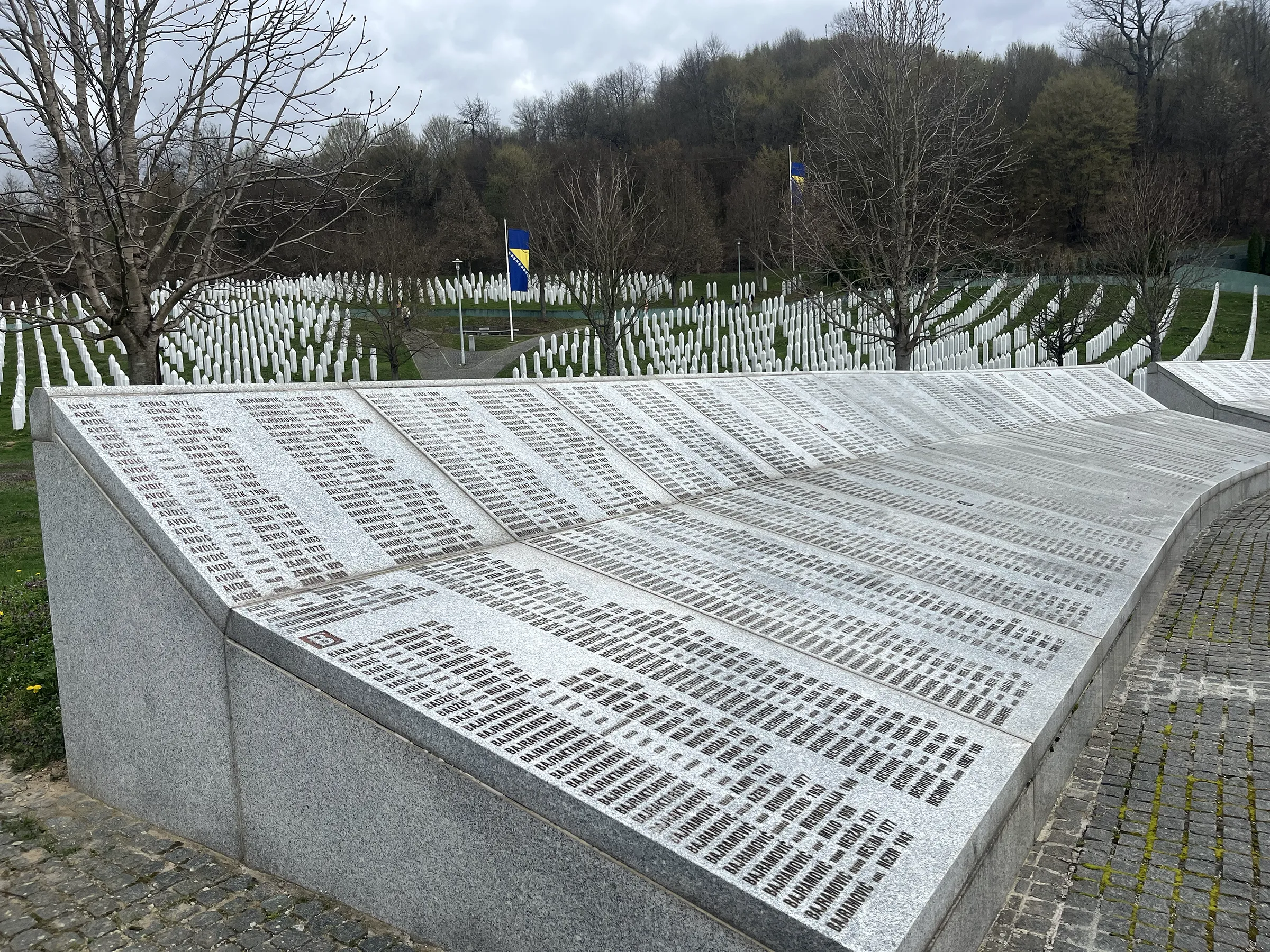
Travel to Srebrenica in Bosnia and Herzegovina, the location of the 1995 Srebrenica Massacre, the first legally recognized genocide in Europe since the end of World War II
Tour the sites of the 1999 NATO bombing of Belgrade, including the TV tower and the Chinese embassy
Explore the religious and cultural history of the region through tours, site visits, or a Balkan style cooking class
Short Study Tour
About this tour
The short Study Tour is designed to introduce you to Danish military and naval capabilities, and their position on crisis areas. You will have the opportunity to meet with military officers, talk with key players in the field, and visit local universities, where you will engage in intercultural dialogues regarding conflict and resolution. You will gain greater knowledge of the complex issues surrounding conflict, such as national identity, the status quo, and the relationship between international human rights law and national law.
The study tour program is also supplemented with cultural visits and events to help you learn more about Danish history and culture, which will give you a more well-rounded understanding of the environment in which the organizations we visit, operate. In the past, cultural visits have included walking with the night watchman on his traditional rounds in the centuries old, winding streets of Ribe, as well as Blokarting on a small island and enjoying traditional Danish food.
Learning outcomes
Gain knowledge of Danish military capabilities, involvement, and position on conflict areas
Understand a variety of Danish views on human rights and international relations
Analyze how the Danish Navy lives up to its human rights obligations during complex law enforcement missions
Possible activities
Visit the Navy Military Police to learn about piracy in Aden bay, practical and legal issues, problems detaining pirates, and experiences from the field
Sit in on a lecture at Aarhus University, which focuses on human rights and international relations, and interact with Danish students over dinner
Tour the remains of the Atlantic Wall on the west coast and focus on Denmark’s role in World War II