In this course, gain an understanding of biology of the polar areas, with a special emphasis on the Northern Hemisphere. Learn how organisms of the Polar Regions are evolutionarily adapted to cold terrestrial or marine habitats with strong seasonality. By studying theoretical and practical case studies, gain insight into population dynamics and species richness within Denmark, and of the Arctic regions in Iceland and Norway.
One course in environmental or Earth science at university level. One course in biology or ecology at university level is recommended.
Study Tour note
Bring appropriate clothing and footwear to stay warm and dry during the Study Tour in potential subzero temperatures. Confidence in hiking on hilly and potentially slippery terrain is mandatory.
Travel on Study Tour
You only take one Core Course per semester, and each Core Course includes two Study Tours: one Short Study Tour to a nearby destination for three days, and one Long Study Tour to another European country for six days.
Led by your faculty, Study Tours take you into real-world settings where you will apply what you’ve learned outside the classroom.
Ph.D. (Distribution, habitat use, behavior, and sound communication), Zoology Dept., Whale Unit, University of Pretoria, 2016. M.S. (Biology and Didactics), University of Copenhagen, 2007. Research associate at Statens Serum Institute, Denmark (2012-2016). TV presenter at “Physics at sea”, Galathea 3 Expedition (2008). Has worked with marine mammals in the field in, Iceland, Northern Norway, Greenland, and South Africa. Local stranding responsible In the Overstrand Region, South Africa (2010-2012). Founder of the Danish Maine Mammal Society (2003). With DIS since 2019.
Jannik Hansen
M.Sc. (Wader/shorebird breeding ecology and behavioural ecology), Dept. of Animal Behaviour, Copenhagen University, 2001. Scientific officer at Arctic Ecosystem Ecology, Department of Ecoscience, Aarhus University (2004-2021), incl. monitoring field work at Zackenberg Research Station, Northeast Greenland (2005-2021). Project officer (2014- ) for and board member (2007- ) of the International Wader Study Group. Has worked with terrestrial animals, primarily shorebirds, in the field in, Denmark, Sweden, Northeast Greenland, central Norway, and Svalbard. With DIS since 2021.
Trine Perlt
M.Sc. in Biology, University of Copenhagen. Employed at Dept. of Biology, University of Copenhagen since 2003. Secretary at Polar Science Centre UCPH (2010-2013). Research and teaching interests include Arctic ecosystems (in particular freshwater ecosystems), phytoplankton, and ice algae. Has over the years worked on several large international research projects and monitoring programs concerning climate change in the Arctic (most recently CBMP-freshwater, ARCTIC-BIODIVER, and Greenland Ecosystem Monitoring). With DIS since 2021.
Long Study Tour
About this tour
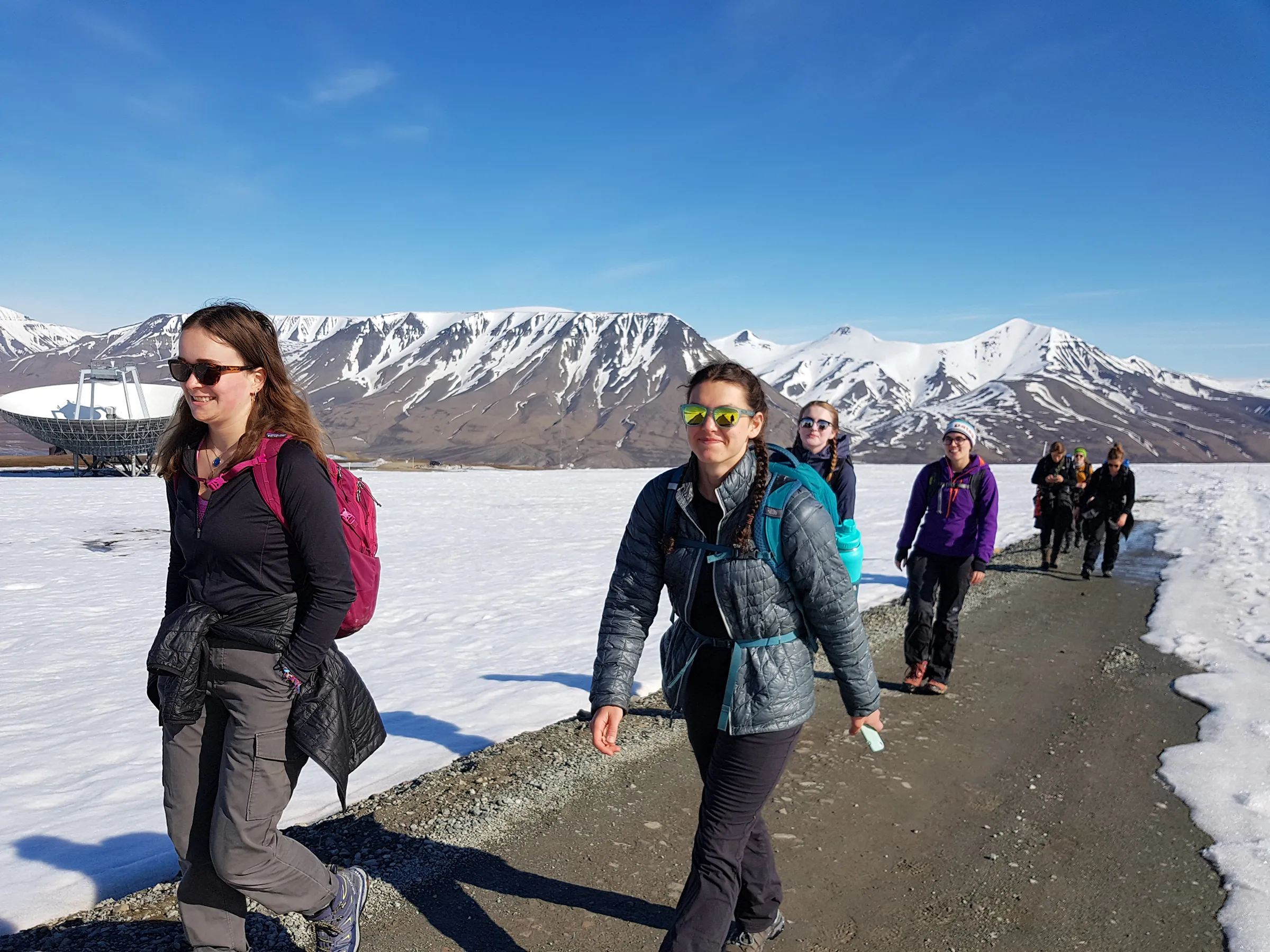
This study tour to Longyearbyen, Svalbard, offers an unparalleled opportunity to immerse in the unique environment of the High Arctic. As the northernmost permanently inhabited settlement on Earth, Longyearbyen provides a living laboratory for studying Arctic ecosystems, climate change impacts, and adaptation to extreme environments.
Through hands-on learning, natural exploration, and interactions with local scientists, you will gain a deep appreciation for the fragile yet resilient Arctic. Svalbard was chosen for its distinct position at the forefront of climate change. With rapidly melting glaciers, thawing permafrost, and unique biodiversity, this destination offers us invaluable insights into the interconnectedness of global systems and allows us to explore these issues firsthand.
Learning outcomes
Deepen your understanding of Arctic ecosystems and their adaptations to extreme conditions
Explore the effects of climate change on permafrost, glaciers, and biodiversity in the High Arctic
Engage with local researchers and institutions to understand ongoing scientific studies in the region
Possible activities
Attend lectures by polar researchers on Arctic ecology, climate change, and permafrost dynamics at The University Centre in Svalbard
Guided field excursions to study permafrost and glacial systems and observe local wildlife (e.g. reindeer, arctic fox, rock ptarmigan)
Polar night sky observations: Stargazing and discussions about light pollution and the aurora borealis in a near-pristine arctic environment
About this tour
This week-long Study Tour to Iceland brings theory from your Copenhagen classes into its natural environment. Iceland is an excellent place for this as it represents the low Arctic, and the fauna and flora have links to neighboring Greenland, reaching into the high Arctic. Adaptations to Arctic life for those species who stay in Iceland over the winter and also for plants and marine life are in focus. We will meet with researchers from Iceland’s well-recognized science community, who are currently studying these issues. Hiking in Iceland gives us the opportunity to see first hand examples of these adaptations. We will also experience Iceland’s unique history and culture, much of it linked to nature and to an extend Greenland/the Arctic.
Learning outcomes
Understand life and biodiversity in Polar regions, and engage with researchers and experts in Iceland
Explore the adaptations of animals and flora to the Arctic climate
Experience first-hand Polar environmental and conduct basic field studies
Possible activities
Visit the Akureyri University (ptarmigan evolution) and the Northeast Iceland Nature Research Centre
Explore the town of Húsavik and visit the Icelandic Institute of Natural History
Visit Akureyri Offices, IASC, and the Rif Research Station (all-year species, ptarmigan, falcons, and Arctic fox)
About this tour
This week-long Study Tour to northwestern Norway will give students a hands-on and very close encounter with the Arctic climate and see magnificent wildlife as well as experience how a modern Arctic society is living.
We will learn about species adaptations to the high Artic environment through field studies to bird colonies, tundra, and forest plant study sites. We will also boat or kayak in the fjords to discuss fish and whale dynamics and competition with fishing industry. During the week, we will study how the dynamics between glaciers and plants are influenced by climate variations, and identify different indicator species on land and at sea.
We will also get to experience how the local Sami lifestyle is dependent on reindeer herding, and their challenges due to reduced areas for reindeer to feed.
The chosen destination provides us with the opportunity to conduct fieldwork while at the same time talk with researchers who are specialists in their fields, as well as gain a cultural experience and have time to socialize.
Learning outcomes
Obtain a first hand experience with the Polar environment and to conduct basic field studies on land and at sea in the area of Tromsø
Explore the wildlife and unique sub-arctic environment north of the polar circle and the history of Arctic explorations from this area
Understand how human activity has impacted the environment and biodiversity of Northern Norway
Possible activities
Visit Tromsø University (UiT), Framcentret (Norsk polarcenter) and Tromsø Museum for guest lectures and examples of how terrestrial and marine research is carried out in the areas
Whale spotting
Visit research sites of plant-glacier dynamics through walking a transect on Kvaløya
Short Study Tour
About this tour
The short Study Tour will offer local insights to how the Danish biodiversity is closely connected to and has a history of more Arctic species. We will study the change of species from when parts of Denmark were covered by ice during the last glacial maximum and up to present time with a more northern temperate/boreal climate.
Students will learn about species adaptations to different climate niches by identifying indicator species on land and at sea and link these to migration routes.
The chosen destination provides us the opportunity to do fieldwork while at the same time talk to researchers who are specialists in their fields.
Learning outcomes
Gain hands-on experiences with the local flora and fauna in the area of the Wadden Sea of West Denmark and how this is a key area for migrating polar birds species
Learn about the area’s rich history of relying on natural resources, and how it is adapting new ideas (e.g. oyster production)
Visit the whale and fossil museum in Gram to witness how climate changes in the past has influenced the species diversity and distribution
Possible activities
“Sea hike” into the the Wadden sea to visit the oyster banks and witness the great shifts in tide and how species adapt to such an ecosystem
Visit the whale museum in Gram (Sønderjylland museum) to investigate how whale species have adapted to different climate niches and extinction events
Attend a research visit at Fjord og Bælt and Fyns Hoved to learn about the newest research within marine mammals and their adaptations to cold environments