

About this course
This course works much like an incubator program. It is aimed at students interested in learning the tools and skills required to succeed as entrepreneurs — and in applying these tools in a real-life project. You work in teams (expect a fair amount of group work!) on your own startup. You get hands-on experience tackling the challenges that all entrepreneurs face and you receive advice from experienced mentors as well as inspiration from visits to startups and scaleups. You assume an entrepreneurial and innovative mindset and use methods like Lean Startup, Business Model Canvas, Design Thinking, Value Proposition Design, and Customer Journey Mapping.
Initially, you identify a problem in need of a solution by looking at customer needs. Through an intensive process, you then build hypotheses about your customers and solution, and you validate these by doing interviews and creating explainer videos, websites, or other representations of your hypotheses. You work toward pitching your business idea to real investors and serial entrepreneurs who give you honest and constructive feedback. You are going to meet some of the main Danish, Swedish, and German players in entrepreneurship, including founders of leading startups.
Syllabus
Course note
This course is cross-disciplinary. You must be prepared to engage and take ownership of start-up projects.
Recommended courses
Consider enrolling in the 3-credit course Entrepreneurship Practicum. You will work in teams as a consultative capacity with entrepreneurs from Danish start-ups to solve a current business challenge that the respective entrepreneurs are facing.

“The experience of this course is phenomenal and the relationships built in class are ones that last long after a our time at DIS. It is an excellent teaching tool for design thought that assists us in creating and marketing products – but also how to market ourselves to prospective employers. Additionally, it is an awesome networking opportunity to link up with the start-up community in Scandinavia. Overall, this core course choice came to be one of the best decisions that I personally made in relation to DIS and my overall abroad experience.”
Faculty

Kirsten Soendersted-Olsen
Executive MBA (AVT Business School, 2012). Executive Board Programme, (INSEAD, 2022). Export Technician, (Copenhagen Technical School and Niels Brock, 1991). Head of Global Pathology Marketing, 2016–2019. Global Marketing Director, 2019–2025 , Agilent Technologie. Marketing and Business Development, Ambu A/S, 1991–2010. Sales & Marketing Director, DELTA/IctalCare, 2010–2013. Board Member, Reccan AB (2020–present. (NOME- mentor), 2016–present. Founder, Insight2Impact, 2025–present. With DIS since 2026.

Marta Leonor Juarez Pena
Ph.D. (Sociology – Danish Assessment of Foreign Education, University of Málaga, 2016). Dissertation: Labour Integration of Skilled Immigrant Women in Denmark: Their Strategies and the Importance of the Mentor Network KVINFO. Adjunkt at Zealand Business Academy (2021–present) and External Lecturer at Copenhagen Business School, Department of Business, Humanities and Law (2017–present). Main research areas: Social sustainability and service innovation at the Service Industries -Tourism and Finantial. With DIS Since 2025.
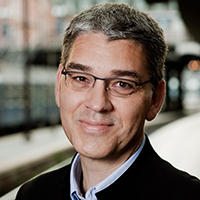
Mikael Fuhr
Architect and Industrial Designer (Royal Academy of Fine Arts, Copenhagen, 1987). +20 years of experience in design management, innovation, communication and leadership. Design manager and project manager in DSB – Danish State Railways, 1998-1999, Head of Design Vision Lab in DSB, Director of Design in DSB, Founding Partner in FUHR, 2011. With DIS since 2013.
Long Study Tour



Short Study Tour
About this tour
Sweden’s entrepreneurial success is the result of long-term vision and deliberate policy. Early investments in digital infrastructure, from subsidized home computers to nationwide broadband, created one of the world’s most connected and digitally literate societies. Combined with a strong welfare state, high trust, and incentives for reinvestment, these foundations gave people the freedom to take risks and shaped a distinctly born global mindset that enabled startups to scale far beyond a small domestic market.
Today, Stockholm stands among the world’s leading tech hubs, home to global successes such as Spotify, Klarna, Skype, and Lovable. Its ecosystem brings together cutting-edge infrastructure, a digitally fluent population, and dense networks of investors, accelerators, and impact-driven initiatives. What has emerged is a culture where innovation fuels both competitiveness and social progress, showing how trust, equality, and long-term vision can sustain entrepreneurship that is as purposeful as it is profitable.
Learning outcomes
- Compare and contrast Denmark and Copenhagen to Sweden and Stockholm’s startup ecosystems and business environments
- Understand the challenges entrepreneurs face in the Nordic market
- Learn from local entrepreneurs and take away new ideas and considerations that will shape your startup’s business decisions
Possible activities
- Learn about the history of entrepreneurship and the Stockholm start up ecosystem with the Stockholm School of Entrepreneurship
- Meet local tech and social entrepreneurs and hear about their start up journeys, their learnings and how they combine business with purpose
- Participate in an upcycling workshop and learn how to innovate and turn waste material into something unique and memorable
About this tour
Core Course Week, including short Study Tour, is designed to give you a more nuanced understanding of how classroom theories apply to the real world environment. You will spend two days in a seminar in Copenhagen and three days in Southern Sweden exploring and analyzing the local entrepreneurship environment.
Through visits to companies and organizations, you will gain a deeper understanding of how Denmark and Sweden promote new start-ups, and how existing companies handle the challenges of competing in a global market. You will also gain insight into how the two countries differ in terms of policies and atmosphere.
The program also includes visits to historical sites, tours of museums, and cultural events to help you learn more about history and culture of Denmark and Sweden, and give you a well-rounded understanding of the environment in which businesses operate.
Learning outcomes
- Compare and contrast Denmark to Sweden’s business environments
- Understand the challenges entrepreneurs face in the Nordic market
- Gather ideas for your own business venture idea and get project feedback from local entrepreneurs and practice your business pitch with experienced entrepreneurs and mentors
Possible activities
- Workshop with the Copenhagen School of Entrepreneurship
- Meet with Swedish startup incubator MINC, as well as local Danish entrepreneurs at Founder’s House
- Attend Pitcher’s Corner at Ideon Science Park – watch pitch development in action as you hear pitches from Swedish university students, step into the role of an investor to give feedback, and learn a professional pitch coach’s model for successful startups